
Helena Ojala and Mikk Orglaan on recruitment and leadership culture
When a leader’s desk is full of fires, look at hiring too
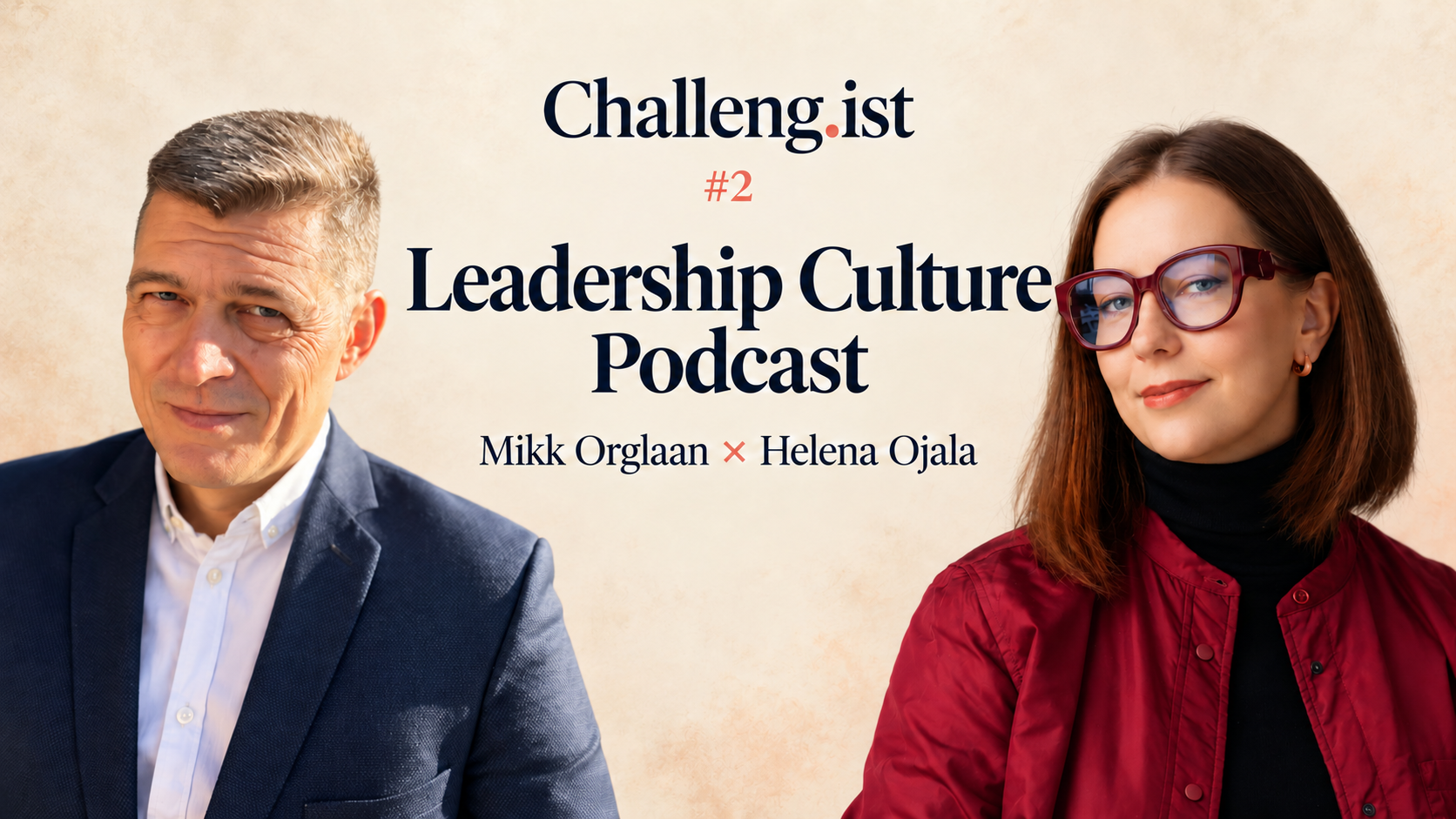
Mikk: This is the second episode of Challeng.ist’s Leadership Culture Podcast. I’m Mikk Orglaan. I work with founders and leaders when strategy, processes or people call for a thinking partner. My guest is Helena Ojala. We had sparred online before, but spent more time together at Äripäev’s Talent Hunt conference, watching four recruiters and four candidates take part in a simulated hiring process. Helena, how did you get into recruitment?
Helena: My career followed two paths. I worked as a psychologist and counsellor while also running business projects. In my twenties, each took turns being my main job. HR brought the business and human sides together. I have worked in HR for about 15 years, much of it in growing companies where hiring and team building directly affect whether a business grows. The simplest description is that I am a recruiter who also thinks about how to recruit better: how to find people who genuinely help a company reach its strategic goals.
Mikk: Sparkly grew out of a practical need in my work. You can think through a strategy and map out processes, but people do not arrive with instructions explaining how they think, behave or work best. Once, I spent four months on a company’s strategy and processes before asking who was meant to carry out the plan. A detailed look at the team led to an uncomfortable recommendation: make changes involving five people, including moving two into roles that suited them better. The leader acted on it and the problem was resolved. That experience made me want to make it easier for leaders to understand the fit between people and work.
HR as part of business strategy
Mikk: In that company, the question was never simply whether a person was “good” or “bad”. For some, the role was too broad and demanding. If one job calls for several conflicting strengths at once, even a capable person may be excellent at being average. That is the painful management question for me: before blaming an employee, check whether the job is even one person’s work.
Mikk: What do you mean by “next generation HR”?
Helena: To me, it is already today’s HR. Personnel work used to be seen mainly as administration: contracts, leave and other procedures. Those tasks still exist, but strategic HR asks what the people function can do to help the business succeed. It becomes part of business strategy, rather than simply administering the consequences.
Mikk: Preparing a talk in Poland, I looked into why people describe US and European HR strategies differently. The administrative burden from EU rules alone did not seem particularly high in that comparison; national obligations, including those related to taxes, change the picture. Poland stood out as having a heavier burden, while Estonia and Ireland had lighter ones. That gives HR in Estonia more room to work beyond administration.
Helena: Regulation affects how work is divided, but so do HR’s own view of its role and the expectations of other business functions. Expectations can differ even within one company. Acting as a strategic partner starts with thinking alongside the business about its goals, team and required capabilities.
How an employee can add work to a leader’s day
Helena: I once asked a senior leader how important recruitment was to him. He agreed that people were vital to the company’s success, but his desk was piled with strategic, tactical and everyday fires. He would only get to the question “Is our hiring working well?” when there were too few hands to deliver what a client was waiting for.
Mikk: Leaders see the financial result: the right people, suitable processes and a sound strategy should lead to results. When the money does not come in, all three deserve a look. Hiring can stay off the agenda precisely when better hiring could prevent some of the fires. A leader should also ask which work genuinely requires their own attention and which tasks could be entrusted to someone better placed to do them.
Helena: When an employee struggles with the work, the leader starts checking them, correcting decisions or taking tasks back. Money limits a small company’s options, but pay alone does not determine ability. The dangerous part is that the leader gets used to the extra work. They may spend years treating an unreliable team as normal, without seeing how their way of selecting people and assigning work contributes to it. A good HR partner can help reveal that pattern.
A good place to work and good performance are different questions
Mikk: I sometimes provocatively say that people are born perfect and then we place them in the wrong environment or under the wrong leader. It is a way of putting some responsibility back on the organisation. The person may not have changed, while their results change as the work, expectations or leadership style change.
Mikk: Employers talk about fruit, coffee, pleasant offices and table tennis. Is that where a leader should invest?
Helena: The work environment affects how good it feels to be at work. Some prefer home, some the office; a table tennis table matters to one person and means nothing to another. The environment also includes colleagues, psychological safety, flexibility and how work is organised. Wellbeing can affect whether people stay and whether they recommend the employer to a friend. It does not, by itself, show that they have the skills or capacity to achieve the result required.
Mikk: In the conversation I cited two figures presented as international statistics: 74% of employers supposedly dissatisfied with their people and 87% of employees supposedly willing to change jobs. Those figures need their sources checked. Does a good environment help performance at all?
Helena: I would not draw the opposite conclusion that a happy employee is a weaker performer. They are different dimensions. Someone on a sales team may love the office yet miss their target; another may deliver twice the target. Wellbeing helps retain people, but a more comfortable chair does not automatically give someone a new sales skill. Equally, an unsafe environment can make work and collaboration harder. There is no reason people should be uncomfortable at work. The useful question is what each condition actually affects.
Helena: If a sales team is expected to win a set number of new clients or reach half a million euros, we can see that some people exceed the goal and others fall short. That performance gap cannot be explained just by how comfortable the office chairs are. Equally, someone who feels bad at work may leave regardless of whether they met their target. Retention and performance need to be examined separately.
A leader cannot switch on someone else’s motivation
Helena: An employer’s image and a pleasant workspace may attract someone to a job ad and encourage an application. Motivation itself changes quickly, sometimes within a day. A leader can create conditions in which a person wants to contribute, but cannot command someone to feel internally motivated. Fear can prompt action for a short time, but it can also cause stress and make people leave.
Mikk: I am interested in a more enduring source of energy: what kind of work makes someone want to learn, explore and create value on their own? In one technical job ad I replaced the usual list of perks with a challenge: every day you will do something you have not encountered before. Only one person applied. That person helped the company out of a very difficult situation. One applicant is not a general hiring goal. The example shows that the wording of an ad can reach a particular mindset, while a large applicant pool does not guarantee a good match.
Helena: You have to consider the person and the work together. No one is equally strong at every task. Sometimes a person is simply in the wrong role without knowing it. Some leaders believe they can turn any hire into a superstar. Leadership matters, but it cannot reshape every person’s abilities, preferences and the demands of the work at will.
A CV does not always reveal potential
Helena: Transferable abilities include communication and learning: people use them across different jobs and outside work. Some underlying traits are fairly stable, while many skills can be developed. Someone may also have learned to hold back their initiative after being punished for asking questions or trying things in a previous environment. Current behaviour alone therefore does not show what they could do with better support.
Mikk: Looking at technical candidates’ past work, I have sometimes seen a weak result and then wondered whether the real issue was the brief or their previous experience. Someone can know their field yet not grasp the problem they are supposed to solve. Another may have spent years in an environment that gave them no chance to show what they can do. How do we look beyond the CV: what makes their eyes light up, what do they want to learn and where might their abilities emerge?
Helena: We need to distinguish current skill from potential to develop. An environment can support or suppress potential, but a pleasant perk cannot create an ability from nothing. The work itself, its pace, the people involved and the daily requirements of the role matter.
Mikk: In developing Sparkly we looked at personality traits, early environmental influences, learned attitudes and models of person-environment fit. I wanted to know whether someone had stopped using an ability because their past environment discouraged it, and whether a more open workplace might bring it out again. Measures can help us ask questions, but no single theory or test result can describe a whole person.
Helena: Fit between work and person is a real issue. A strong programmer, for example, may struggle in an environment that demands rapid public brainstorming all day. But silence in a meeting cannot automatically be attributed to introversion. Perhaps the leader does all the talking; perhaps someone was punished the last time they spoke up; perhaps they prefer to write their ideas down. The leader has to find a way for their knowledge to reach the team.
How much of a psychologist must a leader be?
Helena: Leaders are expected to deliver business results, implement strategy, manage processes and notice every employee’s individual needs. Supportive leadership and psychological safety are valuable, but it is unrealistic to expect every leader to do all that psychological work equally well. One practical option is to hire people whose abilities and working style already suit the work, the team and the leader’s way of operating.
Mikk: New leaders sometimes bring familiar people with them because they know whom they can rely on. In the debate around leadership at LHV, I argued that a leader may want a team compatible with their way of working to make the system more effective. That change can be very uncomfortable for existing staff. It needs to be judged in the specific situation, considering both results and people; changes outside the company can also make a once suitable role unsuitable for someone.
Helena: In a growth company, the product, tasks and team can change fast. That suits some people and not others. Adaptability and resilience can be explored during recruitment. I have advised young leaders who love their area of expertise but are exhausted by constantly resolving missed deadlines, interpersonal friction and skill gaps. They may have no experience of a team that runs more smoothly. If friction has always been there, it feels normal.
Mikk: Elena Koit once helped me think through a hire using the non-scientific Human Design framework. She asked whether I understood that the candidate might work only while I was in the same room. I remember it because I would not have known to ask that question from my own experience. Such a framework does not replace verification, but another person can expose a leader’s blind spot.
A pleasant person is not necessarily the right hire
Mikk: When a leader says they always have excellent people and see no reason to talk about hiring, that may mean their recruitment has worked very well. It may also mean that they judge people only against their previous experience. A problem they have not noticed does not disappear. The opposite danger is reading every disagreement as a personality problem when it could bring a perspective the team needs.
Helena: We naturally favour people who are easy to talk to and resemble ourselves. Being likeable does not prove that someone can do the work. A candidate who disagrees with you may bring real value to the team. That is why hiring needs structure: the reasons for the decision should relate to the work, rather than only to the feeling left by an interview.
Mikk: A person’s important contribution may be invisible in the leader’s spreadsheet. They may hold collaboration together like glue, help strong specialists understand one another and prevent conflict. If the leader pressures that person to produce only a measurable revenue figure, the team may lose the person who was keeping it together.
Helena: Some impact is measurable, some is harder to measure, and some should not be forced into a KPI. The starting point is still to ask which business objective the new person will help achieve. Without a need and an objective, there is no reason to hire anyone.
Recruitment starts with impact, not the job ad
Mikk: Impact can be harder for a leader to see than revenue or hours worked. Before opening a spreadsheet, it is worth looking at what stands between the team and the result promised to the client. Sometimes the whole team waits on one task because it belongs to someone who dislikes it but has not dared say so. At other times, the missing contribution is someone who connects the work of different specialists.
Helena: Start with the goal of the company or department. Then describe the impact the role should have. Will the person help win five new clients, enter two markets, deliver part of a product or keep the team working well together? Only then break that impact into tasks and ask what skills and abilities those tasks require. This groundwork is often skipped.
Mikk: Tasks can also be redistributed within the existing team. I have seen one person delay a task they disliked while another would gladly have done it. Once the tasks were swapped, the whole team moved forward. The original division in a job description does not have to last forever.
Helena: Writing down the tasks may reveal that the planned role contains three people’s worth of work, or that a third of it no longer needs doing. Then the question is not only “Whom should we hire?” but also “How should we organise the work?” Remember, too, that work changes: six months from now the tasks may be different, especially at the current pace of technological change.
Mikk: In a small company, one employee of mine had to cover a wide range of work and could not make much progress. In a large corporation they could focus on a narrow specialty and flourished. I do not take that as proof they were a weak employee. The breadth of the role and the environment had changed. We also discussed cognitive load: eight hours at work does not mean everyone has the same capacity to switch between very different tasks.
Candidates also need to make an informed choice
Helena: The candidate needs a realistic description of the tasks and the actual work environment. The employer is finding out whether the person can do the work. The candidate needs to understand whether they want the work and believe it is within their reach. Willingness and ability are different; ideally, both are present. A count of tasks alone tells little, because tasks can be described at a broad or minute level.
Mikk: Recruiting in the Balkans years ago, I often heard “I’ll do anything.” Later, willingness proved insufficient for the work required. A recruiter can also be such a good salesperson that they oversell the leader and job to the candidate, and the candidate to the leader. The deal closes but the employment does not last. The cost of poor fit does not fall only on the company: someone may have left a job where they were doing well.
Helena: A company must decide how much a new hire can learn on the job and when the skill will be needed. Not everyone can learn everything at the same pace. In a technical role, tomorrow’s problem may be unknown today. Learning speed, applying new knowledge and communicating blockers then become important. If a developer only says “it can’t be done,” the team is stuck; if they explain the precise obstacle, a colleague may know an existing solution or suitable outside help.
Which abilities should we assess?
Mikk: It is tempting to seek intelligence as the universal answer. Yet someone may be capable of several jobs they would never want to choose. Another may have little interest in abstract problem solving but do skilled manual or repetitive work exceptionally well. Fit means asking both “Can they do it?” and “What would they want to do every day?”
Helena: There are very few skills that describe a great employee in every role. Teamwork, negotiation and communication are vital where the work calls for them; some jobs are far more independent. More broadly, cognitive ability is associated with problem solving and learning, but every job does not require the same level of complex reasoning. In some roles, technical knowledge, manual skill or the ability to maintain a routine matters most.
Mikk: A painter helping renovate my flat worked long days and still came over after work. I thought it sounded exhausting. He saw a different surface in every wall, the way light fell and the final effect of the colour. I realised that I had underestimated the complexity and beauty of his work.
Helena: We tend to overestimate how well personality traits predict job performance. One trait that research often links to better results is conscientiousness: finishing what you start, working steadily and keeping commitments. That, too, looks different across jobs. Traits are relatively stable, but people learn to balance weaker areas with skills, habits and tools.
Mikk: I brought up clinical OCD as a comparison, but it is not the same as conscientiousness and is no basis for labelling a candidate. We should assess work behaviour and the task, not diagnose the person.
Introverts, extroverts and proactive employees
Helena: Introversion and extroversion do not in themselves tell you how well someone performs at work. Communication skill and the energy someone gets from company are different things. Mikk mentioned an excellent salesperson who spoke little but closed contracts. I would describe extroversion more in terms of gaining energy from contact with people; introverts more often recharge in a quiet space of their own. The same person may behave differently in different settings.
Mikk: I can spend one day networking actively at a conference and another writing software for hours. The two kinds of work tire me in different ways, and I need variety. Nor does silence in a meeting always mean someone has nothing to say.
Helena: Before assessing proactivity as a personal trait, look at whether the leader allows initiative. In some workplaces, people have previously been punished for speaking up; in some safety-critical maintenance work, following precise instructions is better than constant experimentation. Openness to new experiences may encourage initiative, but the job determines whether it is useful at a given moment. Low openness is not a personal failing when the work calls for stability and thoroughness.
A single test cannot describe a whole team
Helena: Diversity can mean age, cultural and professional background, values and ways of thinking. It may help a team see more possible solutions, but it does not mean every difference automatically improves every team’s result. Safety-critical maintenance and the search for a new product call for different working styles. A profile test may also fail to explain the energy and trust between two particular people.
Mikk: How do we tell whether colleagues make each other more effective? With some people, talking through a problem gives me energy; with others I avoid the same discussion. In Sparkly we have tried to show differences between people and teams from several angles, including Schwartz’s theory of values. Different values may bring the interests of different customer groups to the table, but may also produce competing priorities. Awareness helps the team decide which interests to serve.
Helena: DISC, Belbin and other frameworks for team working preferences can help people discuss how they work differently. The evidence for them and the stability of what they measure vary; someone may get a different result after a few years. They should not be the sole basis for deciding whether to hire someone. Some cover only a few traits, leaving out, for example, conscientiousness or the actual tasks. A diverse team may bring more perspectives, but the benefit also depends on the work the team has to do.
Mikk: At first I thought adding tests based on several theories would automatically produce a more reliable percentage. In practice, the theories describe people from different angles and at different levels of detail. It is useful to compare people within the same measurement framework and treat the result as the beginning of a conversation. A leader needs to understand themselves, their people and the work at hand.
Training helps when both the skill and the way of learning fit
Mikk: When a leader does not know what someone is capable of, they can train them in the wrong direction. I once thought that employees would leave anyway, so why invest in teaching them? That was a mistake: learning can uncover an ability neither the leader nor the employee had noticed. But training built on a missing prerequisite, or delivered in a way that does not reach the learner, may be money spent without a result.
Helena: Awareness matters as much here as it does in hiring. What must the person be able to do, what can they learn and how will the teaching reach them? Mikk described an idea he saw at a hackathon for a system to rate trainers. He asked whether it would account for how the participants learn. A trainer can deliver their method extremely well without everyone in the room actually learning.
A “unicorn” job may conceal several jobs
Mikk: For 21 years I searched for a salesperson who met many very different requirements at once. Looking back, it was as though I expected one person to have 13 personality profiles. I could have divided the sales work into processes and assigned different parts to different people or tools. We added a job ad analysis to Sparkly that helps ask whether one description is really trying to attract two different kinds of person.
Helena: Recruiters call that candidate a unicorn. Some people are good at several different kinds of work, but before searching we should check whether the role is overloaded. Small businesses in particular may not have the money to hire a whole team. Then choose which work is most critical to the business now and what can wait. An “adequate” hire can be costly too: they stay, do some of the work, but the impact the business needed never arrives, often without anyone noticing.
Mikk: I asked whether three quarters of hires fail. Helena rightly pointed out that we first have to define failure before debating a percentage. The usual visible measure is someone leaving during probation. But a missing ability may emerge only at the end of a long sales cycle, or never become obvious. I also mentioned a figure of 30.1 days from an AI-assisted search; it is not a verified general deadline. In one job, a mismatch is clear in an hour; in another it takes months.
Helena: A hire can appear successful even when the person just about manages the work. If we never agreed on the impact required, we may not notice what was missing. A company may also hire for one role, later assign another kind of work and blame the person when results decline. Before judging the employee, find out whether the job itself changed.
First employees and unexpectedly critical roles
Mikk: At first a founder may look for someone who can cover everything, because the company cannot afford separate specialists. Then it is especially important to see what must be done now, what can wait and what can be handed to an outside service or tool. Otherwise a limited budget produces a role so broad that no candidate can perform it strongly.
Mikk: In a small company, the first cofounder or employee is a strategic choice. They need to complement the founder where the most value can be created. If the initial team does not work together, limited resources make big goals even harder. Alongside market demand and funding, a startup’s team can contribute to its failure; we cannot know the cause in any specific company by guessing from outside.
Helena: Critical roles are not necessarily at the top of a hierarchy. In the Disneyland example, cleaners affect the visitor experience: if the park is dirty, the whole value proposition suffers. Mikk recalled a moving company discussed at EBS, where the movers on site create the customer experience and their work appears in reviews. In manufacturing, a mechanic may be crucial because a production line stops without them. Understand how your business works and what the customer experiences before deciding which role is critical.
The recruiter, HR and leader need a shared goal before the search
Helena: A good recruiter is the leader’s consultant and partner, not just a conduit for CVs. A hiring process may involve the manager, recruiter, technical assessor, future colleague and a senior executive approving the budget. Before advertising, they should agree on the impact the new person must have, the work they will do and how to assess the required abilities. At the same table, the executive may want strategic thinking, the technical colleague impeccable code and the manager something else entirely. Resolve that difference before comparing candidates.
Mikk: Without a shared vocabulary, the leader hands the recruiter a vague ideal. They then look through hundreds of CVs and start judging accidental details. Comparing two very different applicants cannot help if the company has not decided what work it needs done.
Helena: Choose assessment methods to match the requirement. A work sample or technical task may help with one skill, a structured interview or an appropriate psychometric measure with another. Each method offers different information and has limits. Candidates should be compared with agreed job requirements, rather than only with one another or with a gut feeling.
Mikk: Where does the recruiter’s job end and HR’s begin? I have seen recruiters’ role underestimated, even though a poor hiring choice can leave everyone else with a serious problem.
Helena: HR is a function, not one job title. In a large company, a recruiter may hand over when the person joins and a separate specialist handles onboarding; in a small one, an HR professional also recruits. The boundary between roles is an agreement. The recruiter, HR and leader can all work towards the same goal: the right people doing the right work and developing with the company. Good HR helps a leader plan team growth, critical roles and people’s development. The leadership decision remains the leader’s responsibility.
Data, intuition and a shared language
Mikk: Many leaders find written analysis easier to consider, but everyone also has instincts. HR and recruiters should be able to bring both to the table. Analytical thinking comes more naturally to me, and I had to practise reading people deliberately. I got better at it, but also learned my limits.
Helena: Data and gut feeling do not exclude one another. HR works with people data, measures and goals, while also needing to understand the context that a number cannot express. Assessment methods and systems are part of the picture too. The central word is awareness: why are we hiring, what will the person do, what impact do we expect, how will we assess it and how will we help them do that work well once they join?
Mikk: That is the leadership question at the heart of our conversation. When leaders understand their own strengths and those of their people, and divide work accordingly, fewer fires may land on their desks. Helena, thank you for the thorough conversation.
Helena: Thank you for having me.