
By Mikk Orglaan
BSV Ventures Deep Tech Demo Day in Helsinki at Maria01
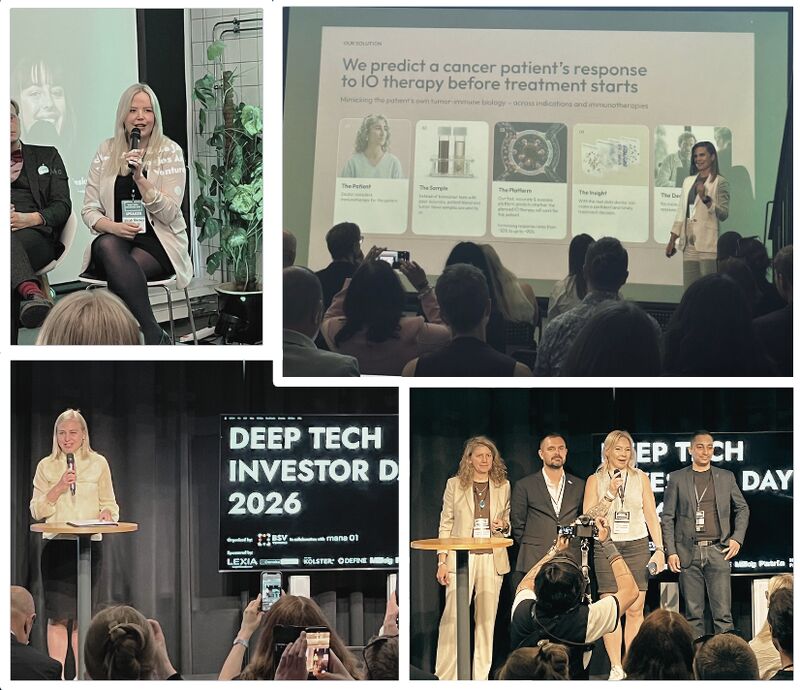
When an investor asks the right questions about HR, you can feel that they've actually invested.
In June, BSV Ventures Deep Tech Demo Day took place in Helsinki, in the Maria 01 startup campus. And honestly — it was one of the most powerful Demo Day formats I've ever seen.
The weather was beautiful. The venue was right. The people were right. But most importantly: the content was strong.
The pitches weren't just the usual line-up where everyone talks about growth, market and technology. They surfaced genuinely interesting angles. You could see that the companies on stage were tackling complex problems, not just the next “quickly scalable app”.
Investors had come in from Central Europe, the New Nordic region and the Baltics. The conversations were substantive, specific and at times surprisingly deep.
I was there with Sparkly HR at the demo area.
Sparkly HR: a person is not a CV or a job title
Sparkly helps companies understand better which person actually works in which role, team and culture.
Not in general. Not in the abstract. But in a specific company, a specific role and a specific team context.
We measure a person's strongest traits, working style, values and fit with the real needs of the role. The goal is not to label people. The goal is to see where a person's natural strengths support the role — and where tension, mismatched expectations or risk start to appear.
Because very often the problem isn't the person. The problem is that the role, the responsibility, the team and the person haven't been put together correctly.
And that costs the company a lot of money.
The quality of investors was exceptionally high
While introducing Sparkly at the demo area, what stuck with me most was the quality of the investors' questions.
Usually investors don't ask very deeply about HR and people. They understand that the team matters, but it often stays at the level of: “Team is everything.”
This time it was different.
They asked substantive questions. They talked about real problems. The conversations went long. And you could tell that these people weren't asking out of theory.
They've invested. They've seen good ideas fall apart because of bad team dynamics. They've had to work out for themselves why some founders don't deliver, why some teams don't work, why conflicts surface too late, and why the “right person” in the wrong role can become a company's most expensive problem.
That changed the level of the whole discussion.
When an investor has lived through the pain, they ask better questions
An investor who has actually seen the price of team problems doesn't only ask: “Do you have a strong team?”
Instead they ask:
“How do you measure fit between co-founders?” “How do you foresee role conflicts before they tear the company apart?” “How do you tell whether a person fits this particular stage?” “How do you distinguish a good person from a person who fits this specific role?” “How do you reduce the investor risk that comes from the team, not the product?”
These are much better questions.
Because a startup doesn't always fall apart because of technology or the market. Very often it falls apart because of people, responsibility, decision-making, communication and blurred roles.
And these problems are usually visible before they become expensive. It's just that nobody measures them in time.
Deep tech needs an even better understanding of people
In deep tech companies this is especially important.
The technology can be very strong. The science can be very strong. The IP can be very strong. But if founders, scientists, salespeople, operators and investors can't work together, strong technology doesn't reach the market.
Deep tech doesn't only need capital. It needs very precise role allocation, patient leadership and the right people at the right stage.
In the early stage, the wrong person may just feel “a bit difficult.” Later it turns into stretched decisions, internal conflict, lost money, burnt-out founders and the cost of wrong hires.
Sparkly's goal is to make those risks visible earlier.
What I took back from Helsinki
BSV Ventures Deep Tech Demo Day sent a strong signal: investors are getting better and better at understanding that team risk is not a soft topic.
It's a business risk. It's an investment risk. It's a scaling risk.
If person, role, responsibility and team culture don't fit, even a great pitch deck won't save the company.
In Helsinki it was interesting to see that investors weren't only asking “is the team strong?” anymore — they wanted to understand how to actually measure and manage it.
That's a very good sign for Sparkly.
Because that's exactly where we're heading: less gut feel, more visibility; fewer late surprises, more conscious decisions about people.
Let's see where these conversations lead next.